

Skip to content
-
Subscribe to our newsletter & never miss our best posts. Subscribe Now!
  • https://www.facebook.com/
  • https://twitter.com/
  • https://t.me/
  • https://www.instagram.com/
  • https://youtube.com/
Globe Narrative Globe Narrative Globe Narrative

GLOBAL PERSPECTIVES. IRUSTED STORJES.

Globe Narrative Globe Narrative Globe Narrative

GLOBAL PERSPECTIVES. IRUSTED STORJES.

  • CURRENT AFFAIRS
    • Africa
    • Americas
    • Asia-Pacific
    • Europe
    • Global Affairs
    • India
    • Middle East
    • World
  • GEOPOLITICS
    • Defense
    • Diplomacy
    • International Relations
    • Security
    • Strategic Affairs
  • ECONOMY
    • Finance
    • Global Economy
    • Markets
    • Startups
    • Trade
  • CLIMATE
    • Energy
    • Environment
    • Natural Disasters
    • Sustainability
  • HISTORY & CONTEXT
    • Forgotten Stories
    • Historical Analysis
    • This Day in History
    • Timelines
  • TECHNOLOGY
    • AI
    • Cybersecurity
    • Future Tech
    • Innovation
    • Space
  • MULTIMEDIA
  • CURRENT AFFAIRS
    • Africa
    • Americas
    • Asia-Pacific
    • Europe
    • Global Affairs
    • India
    • Middle East
    • World
  • GEOPOLITICS
    • Defense
    • Diplomacy
    • International Relations
    • Security
    • Strategic Affairs
  • ECONOMY
    • Finance
    • Global Economy
    • Markets
    • Startups
    • Trade
  • CLIMATE
    • Energy
    • Environment
    • Natural Disasters
    • Sustainability
  • HISTORY & CONTEXT
    • Forgotten Stories
    • Historical Analysis
    • This Day in History
    • Timelines
  • TECHNOLOGY
    • AI
    • Cybersecurity
    • Future Tech
    • Innovation
    • Space
  • MULTIMEDIA
Subscribe
Close

Search

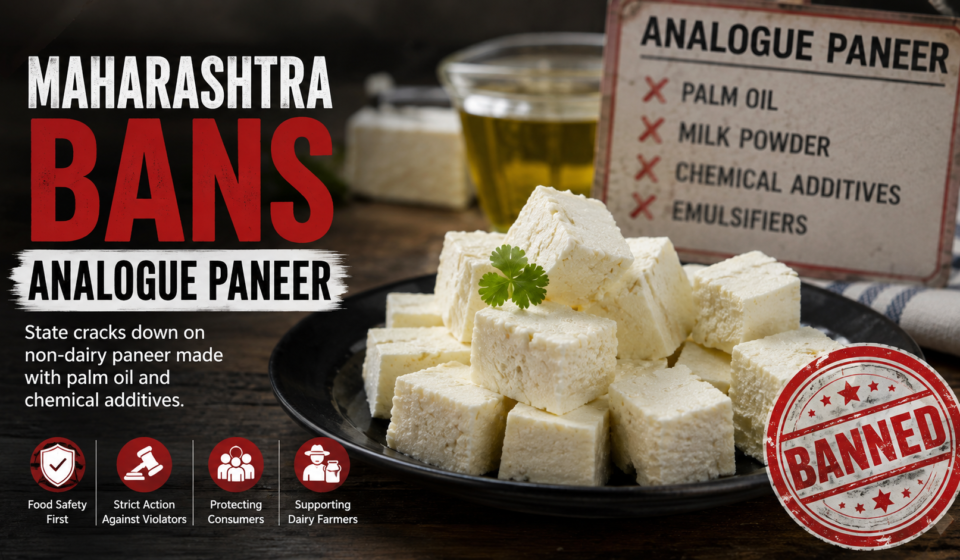
Maharashtra's ban on analogue paneer highlights India's growing fight against fake paneer, food adulteration, and unsafe dairy products. Read the full analysis.
EXPLAINERSIndia

When the Paneer on Your Plate Isn’t Really Paneer: Maharashtra’s Bold Step Against Food Fraud

By Team Globe Narrative
August 6, 2026 4 Min Read
0

Introduction

Food safety has emerged as one of India’s most pressing public health challenges. Every day, millions of consumers trust that the food they purchase is genuine, safe, and nutritious. However, the growing use of counterfeit and adulterated food products has severely undermined this trust. In a landmark move, the Maharashtra government has imposed a statewide ban on the manufacture, storage, transportation, distribution, and sale of analogue (non-dairy) paneer. Violators can face imprisonment of up to six months and a fine of ₹1 lakh under the Food Safety and Standards Act, 2006. The decision follows months of raids on fake paneer manufacturing units across the state.

While the decision has been widely welcomed, it also raises larger questions about India’s food supply chain, regulatory capacity, and consumer awareness.
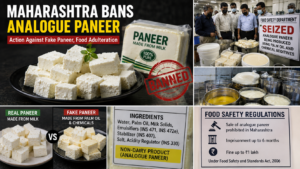

Imagine ordering your favourite paneer butter masala at a restaurant, believing you’re eating fresh dairy paneer, only to discover later that it was made from palm oil, milk powder, and chemical additives. This is no longer a hypothetical scenario. It is exactly the kind of food fraud that prompted the Maharashtra government to take the unprecedented step of banning analogue paneer across the state.

The decision has sparked an important national conversation—not just about fake paneer, but about the larger issue of food safety, consumer trust, and accountability in India’s food supply chain.

More Than Just Fake Paneer

Analogue paneer is not inherently illegal. In many countries, non-dairy cheese alternatives are sold openly to consumers who knowingly choose them. The problem begins when these products are deliberately sold as genuine dairy paneer without proper labelling.

Over the past few months, Maharashtra’s Food and Drug Administration conducted raids at several manufacturing units and found large quantities of products being prepared using palm oil, skimmed milk powder, emulsifiers, and stabilizers instead of fresh milk. These products closely resembled traditional paneer

 in appearance and texture but were significantly cheaper to produce. Investigators believe much of this fake paneer eventually found its way into restaurants, hotels, catering services, and wholesale markets, where consumers had little chance of identifying the difference.

Recognising the scale of the problem, the state government imposed a complete ban on the manufacture, storage, transportation, distribution, and sale of analogue paneer. Violators now face imprisonment of up to six months and fines of up to ₹1 lakh.

A Case That Reflects a Bigger Problem

The fake paneer issue is not an isolated incident. It reflects a deeper challenge facing India’s rapidly expanding food industry.

The economics behind food adulteration are straightforward. Dairy products are expensive because milk production itself is costly. Replacing milk fat with inexpensive palm oil and other substitutes dramatically reduces production costs while allowing manufacturers to sell the product at prices close to genuine paneer. The difference becomes pure profit.

Unfortunately, the victims are not only consumers. Honest dairy farmers lose business, genuine manufacturers struggle to compete with artificially low prices, and restaurants unknowingly risk damaging their reputation by serving counterfeit products supplied through complex wholesale networks.

What makes the problem particularly difficult is that fake paneer often looks almost identical to the real product. Even experienced buyers may not detect the difference without laboratory testing.

Why Regulation Alone Is Not Enough

The Maharashtra government’s action is an important first step, but banning one product cannot permanently solve the problem.

Food fraud adapts quickly. If enforcement remains weak, counterfeit manufacturers simply shift operations to another state, rename their products, or find new ways to bypass inspections.

The real challenge lies in building a system where fraud becomes difficult rather than merely illegal.

India’s food supply chain still suffers from limited traceability. A consumer eating paneer in a restaurant has virtually no way of knowing where it was manufactured or whether it meets food safety standards. Even regulators often struggle to trace products back to their source after complaints emerge.

Building a Smarter Food Safety System

Instead of relying solely on periodic raids, India needs to embrace technology-driven regulation.

Every dairy product sold commercially should carry a QR code that allows buyers to verify the manufacturer, production batch, date of manufacture, and food safety certification within seconds. Similar systems already exist in pharmaceuticals and could be adapted for the food industry.

Artificial intelligence can also play a significant role. By analysing transport records, GST invoices, wholesale purchases, and inspection reports, regulators can identify unusual production patterns that may indicate counterfeit manufacturing before products reach consumers.

Restaurants and hotels should also share greater responsibility. Maintaining digital records of suppliers, invoices, and quality certifications would make supply chains more transparent and discourage the purchase of suspiciously cheap products.

Most importantly, consumers must become active participants in food safety. Public awareness campaigns explaining how to read labels, verify certifications, and report suspicious products can significantly reduce the market for counterfeit food.

An Opportunity for National Reform

Maharashtra’s decision should not be viewed simply as a state-level enforcement action. It offers an opportunity to rethink how India regulates food quality in an era of increasingly complex supply chains.

As the world’s largest milk producer, India has built its dairy industry through the efforts of millions of farmers over several decades. Protecting that ecosystem requires more than occasional crackdowns—it requires consistent regulation, technological innovation, stronger enforcement, and informed consumers.

Food safety is ultimately about trust. Every family that buys paneer from a grocery store or orders it in a restaurant assumes that the product is exactly what it claims to be. When that trust is broken, the consequences extend far beyond a single meal.

Maharashtra’s crackdown sends a clear message that food fraud will no longer be treated as a minor regulatory violation. The challenge now is to ensure that this momentum leads to nationwide reforms capable of making India’s food supply safer, more transparent, and worthy of the confidence that consumers place in it every day.

Tags:

Counterfeit dairy productsFake paneer in IndiaFood adulteration in IndiaFood safety regulations IndiaMaharashtra analogue paneer ban
Author

Team Globe Narrative

Follow Me
Other Articles
Previous

The Rise of the Cockroach Janata Party: A Satirical Lens on Modern Politics and Digital Protest

No Comment! Be the first one.

Leave a Reply Cancel reply

Your email address will not be published. Required fields are marked *

Copyright 2026 — Globe Narrative. All rights reserved. Blogsy WordPress Theme