

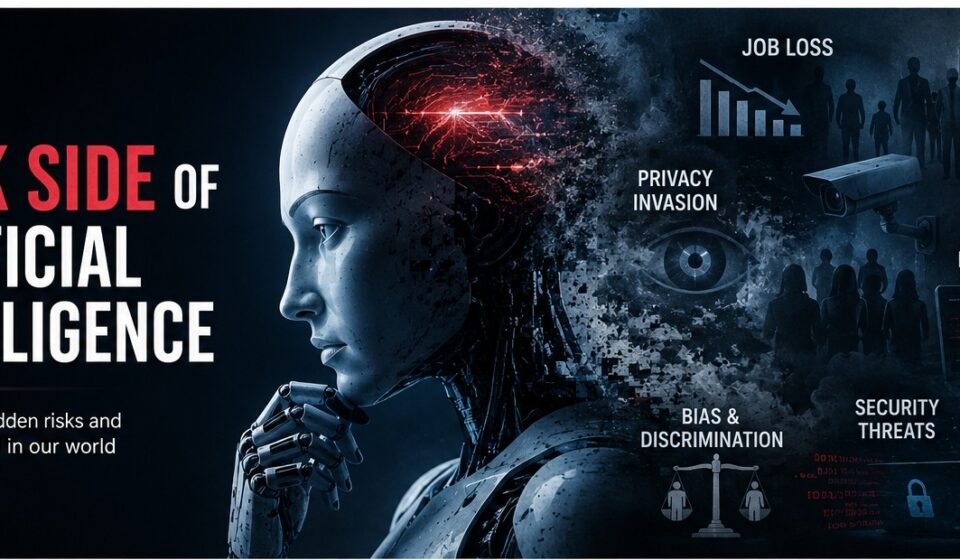
The Dark Side of Artificial Intelligence: Challenges and Risks in the Modern World

Artificial Intelligence (AI) is often described as one of the most revolutionary technologies of the modern era. From voice assistants and recommendation systems to advanced medical diagnostics and self-driving vehicles, AI is transforming almost every aspect of human life. Governments, businesses, educational institutions, and individuals are increasingly relying on AI-powered tools to improve efficiency, productivity, and decision-making. While these advancements offer numerous benefits, the rapid growth of AI also brings significant concerns. Behind the promises of innovation lies a darker side that cannot be ignored. If not managed responsibly, AI has the potential to create social, economic, ethical, and security challenges that could affect millions of people worldwide.

One of the most widely discussed concerns regarding AI is its impact on employment. Automation powered by AI is replacing many routine and repetitive tasks that were previously performed by humans. Manufacturing industries have already adopted robotic systems capable of working faster and more accurately than human workers. Customer service departments increasingly use chatbots to handle inquiries, reducing the need for human representatives. Even professional sectors such as accounting, legal research, journalism, and software development are witnessing growing levels of automation. While new jobs may emerge as technology evolves, many workers may find it difficult to acquire the skills required for these new roles. This transition could lead to unemployment, income inequality, and economic instability, particularly for individuals in low-skilled occupations.
Another major concern is the threat to privacy. AI systems depend heavily on data to function effectively. Every online search, social media interaction, purchase, location update, and digital activity generates valuable information that can be collected and analyzed. Technology companies use AI to study user behavior and deliver personalized services, but the same technology can also be used for surveillance and monitoring. Governments and organizations may track individuals’ movements, communications, and activities on a large scale. In many cases, people are unaware of how much personal information is being collected and stored. The misuse of such data can lead to violations of privacy, identity theft, and unauthorized surveillance, raising important questions about individual rights and freedoms in the digital age.

The rise of AI-generated content has also created new challenges in the spread of misinformation and fake news. Advanced AI systems can now generate realistic text, images, videos, and audio recordings that are difficult to distinguish from authentic content. Deepfake technology allows users to create videos in which people appear to say or do things that never actually happened. Such content can be used to manipulate public opinion, damage reputations, influence elections, and spread false information. In an era where trust in information is already under pressure, AI-generated misinformation has the potential to undermine confidence in news media, public institutions, and even personal relationships. The ability to create convincing false content at a large scale makes this one of the most serious challenges posed by AI.
Security risks associated with AI are equally concerning. Cybercriminals are increasingly using AI to conduct sophisticated attacks against individuals, businesses, and governments. AI can help hackers identify vulnerabilities in computer systems, automate phishing campaigns, and develop malware capable of adapting to security measures. As technology advances, cyberattacks may become more difficult to detect and prevent. Furthermore, AI is being integrated into military systems and autonomous weapons. The possibility of machines making decisions related to warfare raises significant ethical and security concerns. If autonomous weapons are deployed without adequate human oversight, the consequences could be devastating. The use of AI in military operations highlights the need for international regulations and safeguards to prevent misuse.
Bias and discrimination in AI systems represent another significant issue. AI algorithms learn from historical data, and if that data contains existing social biases, the AI system may reproduce or even amplify those biases. For example, recruitment software trained on biased hiring data may unfairly favor certain groups over others. Similarly, AI systems used in lending, law enforcement, or healthcare may produce discriminatory outcomes if not carefully designed and monitored. The problem is often difficult to detect because many AI systems operate as “black boxes,” making it challenging to understand how decisions are made. As a result, individuals may face unfair treatment without realizing that an algorithm influenced the decision.

The growing dependence on AI also raises concerns about the decline of human skills and critical thinking. Many people now rely on AI-powered applications for navigation, communication, research, and decision-making. While these tools provide convenience, excessive reliance on technology can reduce people’s ability to solve problems independently. Students may become dependent on AI-generated answers instead of developing analytical and creative thinking skills. Professionals may trust automated recommendations without questioning their accuracy. Over time, society risks becoming overly dependent on machines for tasks that require human judgment, experience, and common sense.
Another challenge is the impact of AI on human relationships and social interaction. Digital platforms increasingly use AI algorithms to determine what content users see online. These algorithms are designed to maximize engagement, often by promoting content that generates strong emotional reactions. As a result, people may become trapped in information bubbles where they are exposed only to opinions that reinforce their existing beliefs. This can contribute to social polarization and reduce meaningful dialogue between different groups. In addition, increased interaction with AI-powered systems may reduce face-to-face communication, potentially affecting emotional well-being and social connections.
The concentration of power in the hands of a few technology companies is another issue linked to AI development. The creation and deployment of advanced AI systems require enormous amounts of data, computing power, and financial resources. As a result, only a small number of organizations possess the capabilities needed to develop cutting-edge AI technologies. This concentration of power raises concerns about competition, accountability, and control. Decisions made by a handful of companies can influence global markets, public opinion, and access to information. Without proper regulation, the imbalance of power may grow even further.
Ethical concerns surrounding AI continue to generate debate among researchers, policymakers, and the public. Questions arise about who should be held responsible when an AI system makes a mistake or causes harm. Determining accountability becomes increasingly complex when decisions are made by autonomous systems rather than humans. Issues such as transparency, fairness, consent, and human dignity must be carefully considered as AI becomes more integrated into society. The challenge is not simply technological but also moral and philosophical.
Perhaps the greatest long-term concern is the possibility of developing AI systems that become too powerful or difficult to control. While this scenario remains largely theoretical, many experts argue that advanced AI could eventually make decisions that conflict with human interests if appropriate safeguards are not in place. Ensuring that AI systems remain aligned with human values is one of the most important challenges facing researchers today. The future of AI depends not only on technological innovation but also on responsible governance and ethical oversight.
In conclusion, Artificial Intelligence has the potential to bring remarkable benefits to humanity, but its darker side cannot be overlooked. Job displacement, privacy violations, misinformation, cybersecurity threats, discrimination, social polarization, ethical dilemmas, and the concentration of power are among the significant risks associated with AI. As society continues to embrace this transformative technology, it is essential to establish strong regulations, promote transparency, and encourage responsible development. AI should serve humanity as a tool for progress rather than becoming a source of harm. The challenge for the future is to balance innovation with responsibility, ensuring that technological advancement remains guided by human values and the collective good.